Google Ads is expanding asset optimization in Performance Max with two new features that allow advertisers to automatically source images and videos from existing online content.
What’s new
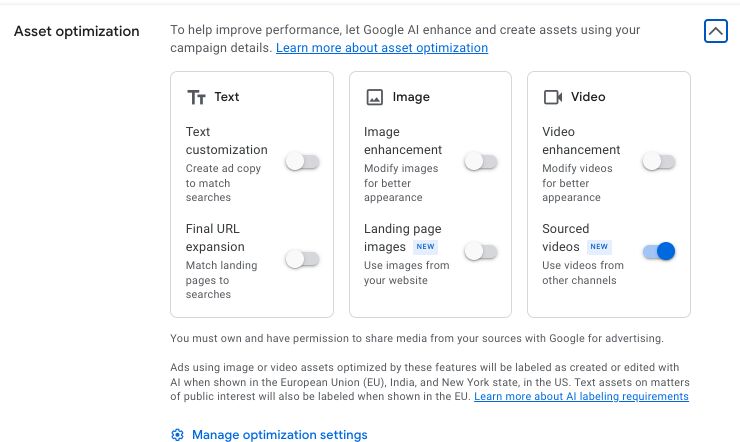
Two features are marked as new in the Performance Max asset optimization settings.
- Landing page images: Allows Google to use images from an advertiser’s website as creative assets. This option appears under Image optimization.
- Sourced videos: Allows Google to use videos from other channels. According to the advertiser who spotted the feature, sources can include social media, campaign landing pages, and linked YouTube channels.
The advertiser also reports that Google can automatically add up to 10 sourced videos to an asset group, compared with the five-video manual upload limit described in the original post.
How it works
The new features are part of Google’s broader Asset optimization settings, which are divided into three categories.
1. Text optimization
- Text customization: Allows Google AI to create ad copy that matches relevant searches.
- Final URL expansion: Allows Google to match searches with relevant landing pages.
2. Image optimization
- Image enhancement: Allows Google AI to modify existing images to improve their appearance.
- Landing page images (NEW): Allows Google to source images directly from the advertiser’s website.
3. Video optimization
- Video enhancement: Allows Google AI to modify videos to improve their appearance.
- Sourced videos (NEW): Allows Google to use videos from other channels
Each feature has its own toggle, giving advertisers control over which optimization options they enable.
The important detail
In the shared screenshot, Sourced videos is switched on, while Landing page images and the other visible optimization settings are switched off.
The advertiser who discovered the feature reports that Sourced videos is enabled automatically.
Advertisers should check their own settings rather than assume the feature is disabled.
Why we care
The updates could make creative asset management easier, particularly for businesses with large collections of existing images and videos. Landing page images could help advertisers reuse product photography and other website visuals without uploading them individually.
Sourced videos could provide Performance Max with additional video assets beyond those manually supplied by the advertiser. Together, the features may reduce the time needed to prepare creative assets and give Google’s systems more material to work with.
Labelling
Google’s interface notes that ads using image or video assets optimized by these features will be labeled as created or edited with AI when shown in the European Union, India, and New York state in the US. Text assets on matters of public interest will also be labeled when shown in the EU.
What advertisers should do
Performance Max advertisers should review the Asset optimization section of their campaign settings.
In particular, they should check whether Landing page images and Sourced videos are enabled, review the content Google may access, and confirm they have the necessary usage rights.
Advertisers who prefer to control their creative assets manually can switch off the relevant options.
The bottom line
Google Ads has introduced two new Performance Max asset optimization options: Landing page images and Sourced videos. Both could help advertisers expand their creative libraries with less manual work, but businesses should review their settings and ensure any automatically sourced content is suitable and authorized for advertising.