Google has introduced a new question_and_answer attribute in Merchant Center, allowing retailers to submit up to 30 product-specific questions and answers for each item in their Shopping feeds.
Ayisha Yousef, Fractional Head of Growth, highlighted the update and shared her approach to helping ecommerce advertisers use the feature effectively.
Why it matters
Shopping behavior is becoming increasingly conversational, with customers asking detailed questions rather than relying on broad product searches.
Instead of searching for "gym leggings," shoppers might ask whether leggings are squat-proof, suitable for running and weight training, or see-through when stretched.
These questions can influence purchasing decisions but aren’t always answered clearly in traditional product feeds.
Google’s new attribute gives retailers a structured way to address them.
What’s new
The question_and_answer attribute allows merchants to add up to 30 Q&A entries per product.
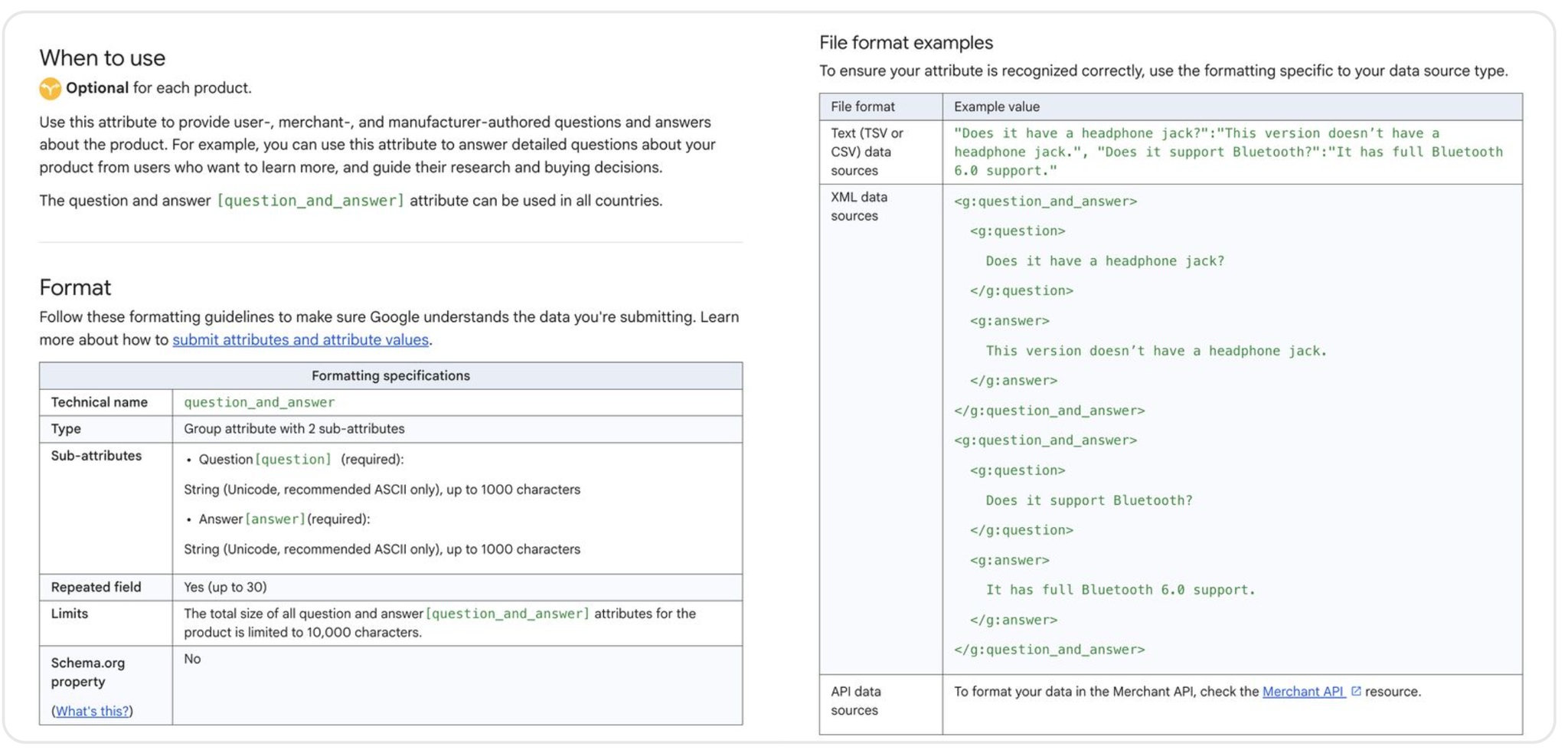
Retailers can use it to provide information about:
- Product compatibility and suitability.
- Features, materials and sizing.
- Installation and usage instructions.
- Common concerns that influence purchasing decisions.
The information can be submitted through a primary feed, supplemental feed or Merchant API.
The AI connection
Yousef highlighted the feature’s relevance to conversational shopping experiences, including Google’s AI Mode.
As consumers increasingly ask specific, natural-language questions, providing detailed product answers could help Google better understand what an item offers. However, the feature doesn’t guarantee greater visibility in AI-powered shopping results.
How to approach it
Rather than immediately adding 30 questions to every product, Yousef is taking a measured approach to introducing the attribute into ecommerce account plans. Her strategy focuses on four steps:
1. Start with customer insights. She recommends speaking with clients and their customer service teams to identify frequently asked questions, common buying concerns and reasons for product returns.
2. Prioritize relevant products. Focus first on products where compatibility, suitability, installation or usage details could make a meaningful difference to purchasing decisions.
3. Build accurate answers. Work with clients to validate product information before adding it through a primary feed, supplemental feed or Merchant API.
4. Test before scaling. Begin with a limited selection of products, confirm that Google processes the attributes correctly and monitor any observable changes before expanding the rollout.
Why we care
Yousef’s approach emphasizes improving product information rather than simply filling every available Q&A field. For example, a clothing retailer might address sizing and material concerns, while an electronics retailer could clarify device compatibility. The goal is to answer questions that genuinely matter to customers.
The catch
Yousef cautions that adding Q&As doesn’t guarantee better Shopping rankings, lower CPCs or improved Performance Max ROAS. The feature shouldn’t be treated as a shortcut to stronger campaign performance. Instead, she sees it as an opportunity to improve product information and prepare for more conversational product discovery.
The bottom line
Google Merchant Center’s new Q&A attribute gives retailers a way to provide richer product information. Ayisha Yousef recommends starting with customer insights, prioritizing relevant products and testing carefully before scaling, rather than assuming the feature will automatically improve advertising performance.