Introduction
Ecommerce category pages have an opportunity to earn AI search citations, particularly when shoppers are comparing products and weighing their options.
Wix Studio analyzed more than a million AI citations and found that category pages accounted for 12.42% of citations for commercial-intent prompts, compared to 7.14% for product pages. For informational prompts, category pages accounted for just 1.74%.
The findings suggest that optimizing category pages for AI search requires a sharper focus on buyer intent and content that helps shoppers make decisions.
Category pages perform strongly in one intent band but underperform in others
The Wix Studio study cited above analyzed 75,000 AI answers and more than a million citations from ChatGPT, Google AI Mode, and Perplexity. All prompts were nonbranded and spanned five industries, including ecommerce.

Source: Wix Studio AI Search Lab, “The content types most cited by LLMs,” March 2026. Based on 75,000 AI answers and 1,056,727 citations.
Product pages led across all query intents except commercial intent, where category pages received nearly twice as many citations.
In this context, category pages receive nearly twice as many citations as product pages. For informational prompts, the opposite holds: category pages rank near the bottom among all content types measured by Wix.
Optimizing category pages for informational prompts targets the one area where they have consistently underperformed.
The study’s key finding is that query intent predicts content-type citations more accurately than industry or model. Wix describes model differences as “overrated.”
However, two caveats remain: Wix doesn’t disclose its data collection window or explain how pages were classified into the different content types. These numbers show citation shares, not the chances that your specific page will be cited.
Key takeaway: The intent range for your category page is narrower than your keyword list may indicate.
Why the studies seem to disagree
This year, three studies reached different conclusions about the same page type.
In April, Gradial tested 28 retail and consumer brands, running 20 queries each on OpenAI, Anthropic, and Perplexity. Product listing pages “almost never appeared.”
DeltaV Digital tracked 21,075 AI responses from April to July and recorded 25,337 citations. Category pages accounted for 5.2% of citations.
Source: DeltaV Digital, “AI citation study,” April-July 2026. Based on 21,075 AI responses and 25,337 citations.
Wix reported a citation rate of 12.42%. All three results are correct. The difference comes from the mix of prompts used.
Gradial tested both buying and research intent. Wix separated results by intent and published those findings.
DeltaV’s prompts focus on commercial topics, but its eight-brand panel excludes ecommerce brands. Instead, it covers B2B technology, medical aesthetics, healthcare, higher education, automotive, cybersecurity, specialty food, and government scholarships.
To complicate things further, Kevin Indig’s Growth Memo analyzed 20,000 prompts in May. The analysis found that category pages made up 1.6%, which is higher than product pages at 1.2% but lower than guides at 2.3%.
This figure measures portability, not overall share. It reflects the percentage of each page type’s citations that appear in all three engines for the same prompt.
Only 2.37% of cited URLs appear in all three engines. The rest are unique to each engine.
Indig’s panel is weighted toward the EU, and his page-type labels are based on regex rules he describes as “directional rather than authoritative.” One more factor links these datasets: Wix, DeltaV, and the Ten Speed figures below all use Peec AI.
Three of the four page-type studies referenced here use the same data provider.
Key takeaway: Citation rate depends on the prompt set, not on your specific page.
What retrieval actually does with a category
Retrieval systems can already identify the relevant category. Labeling isn’t the primary limitation.
Rauf Aliev published a paper on category-aligned retrieval that directly tested this concept. The system predicts the product category from the query and prioritizes products within that category.
After training, the system’s top-three category prediction accuracy improved from 43.8% with no prior examples to 83.2%.
However, the most significant result is that, despite improved category accuracy, overall search quality didn’t increase.
Boosting by category can reduce performance. Aliev explains that this happens because some queries are ambiguous, and retrieval systems may overreact to strict filters.
He suggests using "confidence-aware and adaptive integration strategies."
From a category page perspective, accurate category prediction doesn’t always yield the most relevant product selection. Applying a strict category filter reduced result relevance.
JD.com’s Oxygen AI Item Center paper demonstrates the scale of this challenge, with tens of billions of SKUs and automated fill rates for key attributes exceeding 80%.
Key takeaway: The system doesn’t rely solely on user-provided categories. Instead, it determines the level of confidence in its own predictions.
Citation doesn’t equal recommendation
Being cited and being recommended are distinct outcomes.
In June, our team analyzed 11,400 AI shopping responses from ChatGPT, Perplexity, and Gemini. Category structure didn’t influence whether a brand was recommended on these platforms.
In contrast, consider the citation data.
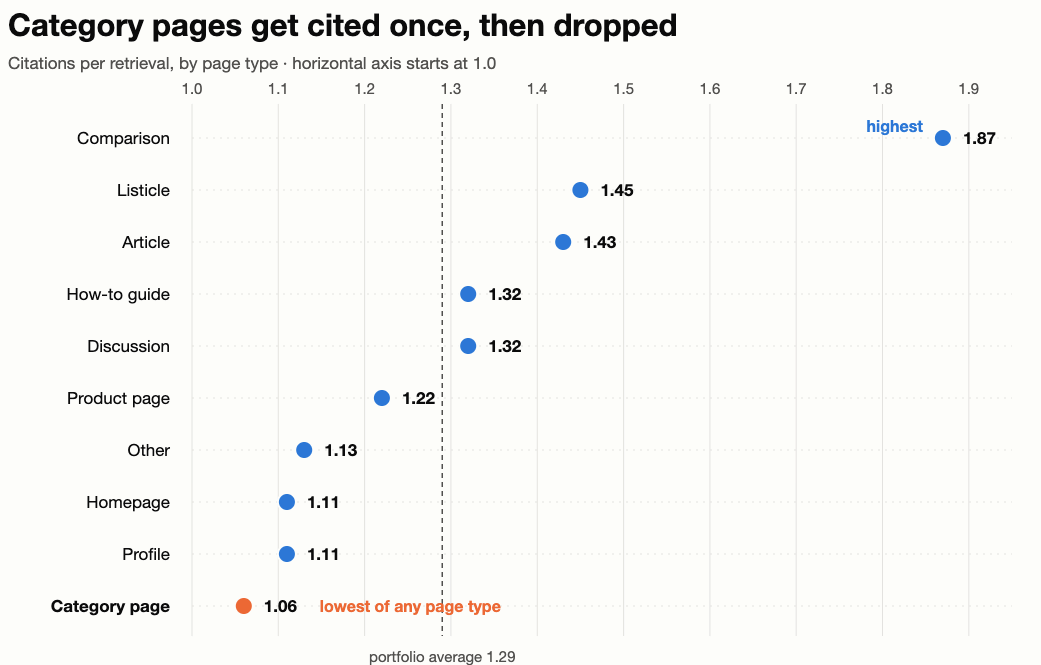
DeltaV reported citations per retrieval alongside citation share. Category pages scored 1.06, the lowest of any page type. Comparison pages scored 1.87.
Category pages are typically used, cited once, and then disregarded.
Gradial’s data reflects a similar pattern. One global footwear brand received an 88% mention rate but only a 2% citation rate. A farm supply retailer in the same study achieved a 47% mention rate.
Mentions and citations don’t always align. The same is true for citations and recommendations. This pattern isn’t new and appears to be increasing. Lily Ray tested 100 “best B2B software” queries in Google AI Overviews and found that brands ranking themselves No. 1 in their own listicles were cited but excluded from recommendations 69% of the time.
When she repeated the test in September, the exclusion rate rose to 83%. Surprisingly, the top spot went to a larger competitor on the same list.
Key takeaway: Even if an answer references your category page, it might not appear in the final recommendation list.
The product feed doesn’t describe an entire collection
All attributes accessible to AI shopping are defined at the product level.
At Google Marketing Live in May, Google added six conversational attributes to the Merchant Center product data specification. They cover question_and_answer, document_link, related_product, item_group_title, variant_option, and popularity_rank. These are optional and don’t affect whether your product gets approved.
In July, Google began supporting the product category property in merchant listing structured data, covering both its own taxonomy and your product types.
The gap becomes evident here. You can indicate that a product is frequently purchased with another, requires a specific part, or serves as a substitute for a competitor’s item.
There isn’t a field in the feed to describe the purpose of your collection, its target audience, or the distinctions among its items.
Lily AI points out something useful to keep in mind: leaving optional attributes empty doesn’t cause any feed errors. These gaps won’t show up in your feed health reports.
Key takeaway: The feed describes individual products, while only your category page provides context for the entire set.
The fastest-growing segment
The primary group of search results where your category pages compete is also experiencing the most growth.
Semrush analyzed more than 600,000 U.S. desktop keywords across 10 industries between November 2025 and April 2026.
AI Overviews appeared 71% more frequently on commercial-intent search results pages. On transactional-intent search results pages, its presence decreased by 5%.
SE Ranking’s AI Mode shopping research, published in November 2025, found that the shopping module appeared in 61.66% of ecommerce queries, compared to only 4.62% of general queries. This is approximately 13 times more frequent.
The same study highlights the competitive landscape for brand sites. Among the top 50 sellers by product listings, eBay showed up in 86.65% of cases. Amazon didn’t appear in the top 50 at all.
Brand sites face significant challenges. For example, Apple.com appeared 21 times across 140 products, while eBay appeared 585 times. Sony was absent entirely, compared to eBay’s 245 appearances.
Editorial content appears within product cards. “Top Insights” expert and analysis links were present 62.4% of the time. Discussion and forum sections appeared in over half of product cards, with Reddit featured in 97.5% of those instances.
Key takeaway: Editorial analysis is surfacing inside the shopping module. Your category page isn’t.
The true test will occur in Q4
On Oct. 15, the National Retail Federation predicted $1.013 trillion in U.S. holiday sales for November and December, which is a 4.2% increase over last year’s $972 billion.

Source: NRF Forecasts 2026 Holiday Sales Growth as Consumers Remain Resilient
Adobe estimated that online sales would reach $275.1 billion and projected AI-referred traffic to U.S. retail sites would increase by 130% compared to last year.
Salesforce’s estimate is even more notable. It expects AI chat agents to generate 20% of all 2026 holiday ecommerce traffic.
The same analysis found that engagement on brand-owned websites declined by 7% compared to last year.
As a result, about one in five holiday shopping sessions will occur through a channel that reads your category page rather than displaying it directly to shoppers.
Key takeaway: Your collection pages will be evaluated this quarter, even if shoppers don’t see them directly.
What this means for your category pages
Pages are cited for their selection logic, not merely for listing products.
DeltaV’s rate column highlights that, on average, comparison pages receive 1.87 citations per retrieval, while category pages receive 1.06.
Comparison formats help users make decisions, whereas standard category pages only list available options.
Gradial’s most cited pages followed this trend. Top performers included buying guides with specifications and comparison data, sizing and fitting information, return policies, and color selection tools.
They noted that AI models favor pages that answer user questions over those focused solely on sales.
Ten Speed analyzed 7,387 citations in a September study. Comparison-format prompts accounted for 27% of citations, despite representing only 20% of prompts. As the study focused on B2B software, use these findings as a general reference for retail.
Consider implementing these three changes:
- Add selection logic to your collection pages. Include attribute comparisons, clarify which products suit specific needs, and highlight key differences.
- Address specific customer needs rather than only the category. For example, include use cases such as “for the beach” or “for a three-day trip” to align with buyer intent.
- Don’t rely on schema as your main tool. Claims that CollectionPage or ItemList markup boosts AI citations come from vendors, and there aren’t any controlled tests to support them.
Key takeaway: Category pages are cited when they explain how to choose, not just when they list products.
A new role for category pages
Traditional SEO for category pages still matters. Titles, internal links, and crawlable facets continue to influence Google rankings.
The evaluation criteria for these pages have changed.
Category pages were once viewed as simple product lists. Now, they are considered answers to comparison questions, particularly as AI search expands.
Pages that are cited explain how to make informed choices. Most category pages still only display available inventory.