Fear of Linking to Competitors
I’ve been doing SEO for a long time. Seventeen-plus years. And while plenty has changed since I started, one thing has never, ever, changed: the fear of linking to a competitor.
You’re reading a blog post, a “best of” list, or a comparison, and you notice one of two things. Every outbound link is nofollowed, or competitors are mentioned by name without a hyperlink.
My favorite? “Top X SEO Newsletters.” and “Best Y SEOs” posts. The publisher’s newsletter/brand is ranked first, of course, with a nice clickable link to subscribe. The other nine? Apparently, you can Google those yourself.
 I’m opting not to link here out of respect for people who don’t know this business’s name. However, if you’re the owner and you want your link at the cost of being identified, email me.
There are legitimate reasons to be careful about naming another brand. If you can’t verify a claim or fairly represent its offerings or services, you probably should reconsider including it. But “they compete with us” isn’t an editorial standard; it’s editorial cowardice.
The people making these linking decisions think they’re being clever. They aren’t. They’re making their supposedly helpful content less useful and giving readers a reason to question whose interests the recommendations serve.
Most importantly, it makes them look ~~like a butthead,~~ untrustworthy.
If they’re good enough to recommend, they’re good enough to link to.
There’s a difference between someone dropping a link into your blog comments and your editorial team deliberately recommending a resource. One was ~~deliberate spam~~ submitted by someone else. The other is something you chose to publish because you believe it deserves your reader’s attention.
If you’ve decided a competitor belongs on your list, finish the recommendation. Link to it! Making readers copy the name and search for it themselves adds unnecessary friction to the very thing you’re supposedly “helping” them discover. You might get better outcomes by giving them the 🖕 upfront.
Hoarding your link juice and automatically not following those links because they’re a competitor; if so, explain your reasoning. You evidently trust them enough to recommend them to your audience. Why does this suddenly change when it’s time to add the hyperlink?
Not linking, or not following external links, is a “tell” sign that someone is writing exclusively for themselves rather than the audience they think they are attracting. (Human > Bots, folks!)
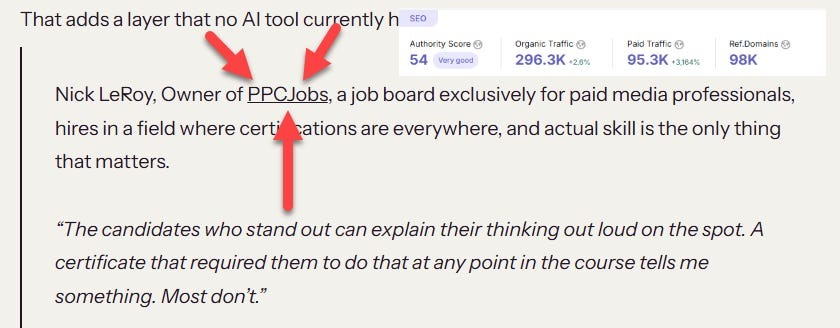 This authoritative + high-traffic site has journalists who “get it”. Linking my name or brand doesn’t hurt them; it strengthens the point in their post
You don’t have to be the best solution for everyone.
My day job is ~~truth teller~~ SEO consulting. That doesn’t mean every business needs to hire me. Some need an agency for scale, an employee to advocate internally, a specialist for a specific tech stack, or just a few hours of advice. Pretending otherwise would make me a horrible consultant.
Many times I tell leads that I may not be the best solution but make introductions to who I think will be. While not always true, I like to think what comes around goes around.
The same applies to your news coverage, comparison pages, resources, and product recommendations. Different budgets, priorities, and problems lead to different answers. Your offering can be excellent without winning every category you invent for the comparison table.
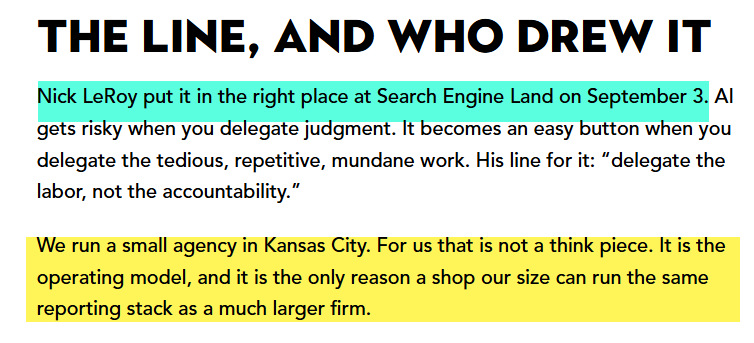 This website mentions me and the concept of a post I wrote for Search Engine Land. No link, but an equally long paragraph showing THEY think like this too. Same rule applies: withhold the link/company name, but email me if you only care about the link; I’ll give it to you, at the expense of your reputation.
Yes, an honest recommendation might send someone elsewhere. But helping someone recognize a better fit gives them a reason to trust your judgment. Declaring yourself the winner every time gives them a reason to question it.
Their research isn’t yours just because you removed the hyperlink
This gets especially irritating when a company borrows a competitor’s research to strengthen its own argument, then decides that linking to the source would give away too much.
 Matt Southern of Search Engine Journal and I are utilized as social proof for a section of their article. No links, just text, but no way for their readers to validate/read on.
Give people a direct path to the original research. Let them inspect the methodology, understand the context, and decide whether your interpretation holds up. A company’s status as your competitor doesn’t reduce its contribution to your argument.
You wanted the credibility that came with their findings. Accept the responsibility of properly sourcing them.
‘Best practice’ is a weak excuse for a worse experience
I’m tired of “SEO best practice” being used to end conversations that should require an explanation. What problem are we solving by withholding this link? Why does the same resource deserve a normal editorial link until we realize who owns it?
If your entire answer is “they’re a competitor,” you haven’t explained the benefit. You’ve identified the company you’re afraid to help.
Editorial judgment means evaluating the resource, its relevance, and whether it supports what you’re telling readers. A blanket rule saves you from making that decision.
 Wix.com gets it too. Citing my newsletter didn’t take away from their article, but it did allow the readers to tie the quote to a person and source.
If your best practice makes a recommendation harder to use or its evidence harder to verify, it’s time to reconsider the practice.
Value is value, which is why you should check out these SEO newsletters by Mark Williams-Cook, Aleyda Solis, Eli Schwartz, Kevin Indig, and Duane Forrester. Each is worthy of this ultra-rare and prestigious “follow” link. Sooo, here’s to hoping my link juice doesn’t dry up!
This post first appeared on the author’s website and is republished here with permission.