How to build a visual SEO strategy for AI search
Move beyond optimizing individual images by connecting visual assets to authoritative entity data and keeping those signals consistent.
Published on September 29, 2026
Images and videos have long been important SEO assets. Now, they are also inputs that AI systems interpret, connect to entities and context, and use to help people discover and evaluate brands.
The challenge is no longer simply making an image understandable. It’s keeping the image, entity, context, and supporting data aligned wherever that asset appears. AI systems can understand an entire scene, identify multiple entities and attributes, connect them to context, and help consumers move from recognition to interest:
- “I see it.” → “What is it?” → “Is it right for me?” → “Where can I get it?”
The scale of visual search makes it increasingly important for marketers. Google reports that Lens powers more than 25 billion visual searches each month, with one in five showing commercial intent.
For marketers, this creates a different optimization problem. An image can be technically searchable yet difficult for an AI system to interpret correctly. Visual assets need to be discoverable, understandable, contextual, and connected to the entities they represent.
Visual search is increasingly becoming part of how AI systems discover, interpret, and recommend brands.
Visual search is now a multimodal discovery layer
Visual search is moving beyond image matching and into multimodal discovery. AI systems can identify products, places, objects, and attributes within a scene, understand relationships between them, and connect those signals to user intent. They can also examine different parts of an image and use multiple retrieval steps before forming an answer.
For brands, this means a visual can convey more information than its subject alone. For example, a product image can display attributes and features, hotel photography can communicate room types, amenities, and settings, and restaurant imagery can signal cuisine, dishes, and dining experiences.
This shift is both structural and conversational. Traditional search and multimodal search now run on different underlying paths:
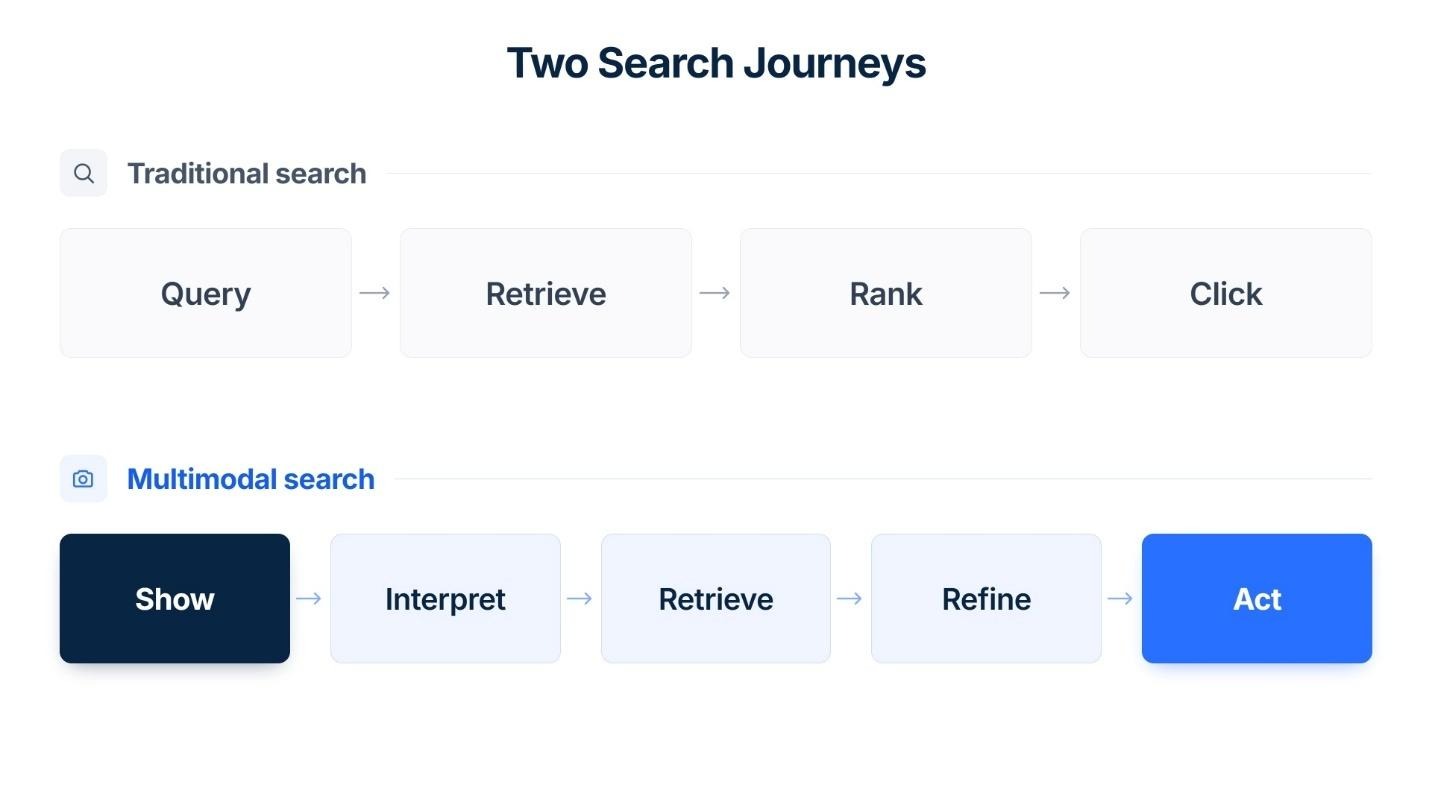
Once a visual becomes searchable information, the optimization problem changes. The image itself is only one signal. AI also needs to understand what the visual represents, which entity it belongs to, what context surrounds it, and whether that information is current.
For enterprises managing thousands of assets across websites, locations, feeds, and third-party platforms, the larger challenge is keeping those signals consistent.
Semantic visual search changes the job of optimization
When optimizing for visual search, the fundamentals stay the same: crawlability, filenames, alt text, captions, transcripts, surrounding content, and structured data. But these optimization points now serve a bigger purpose — helping AI understand what a visual represents and how it connects to an entity and context.
Semantic visual search is based on meaning rather than just keywords. With visual search fan-out, AI can analyze different parts of an image, recognize objects and attributes, understand relationships, and simultaneously run multiple searches to interpret intent.
This changes optimization into an ambiguity-reduction problem where the following three points all need to align:
- What the brand intends.
- What the customer sees.
- What AI understands.
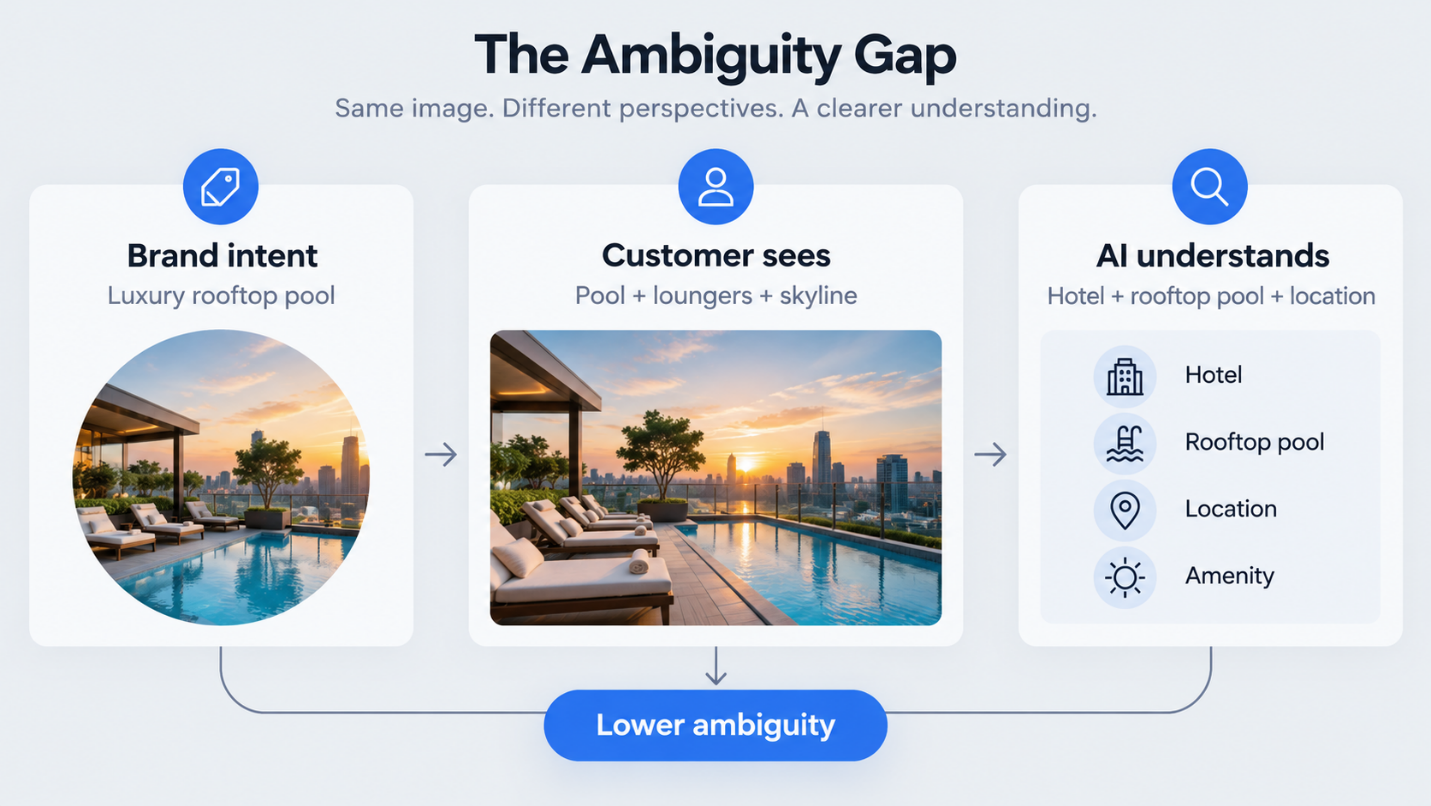
The image is no longer an isolated asset. It’s a signal within an entity system.
A hotel image should connect to the correct property, room type, amenity, and location. A product image should connect to the correct product, attributes, price, and offer. A video should have transcripts, metadata, and surrounding content that establish what it represents.
The goal is consistency: The visual, page content, metadata, structured data, and underlying entity should all describe the same thing.
At enterprise scale, visual optimization is no longer primarily an asset-tagging exercise. The unit of optimization is now the relationship between the asset, the entity, and its context.
5 must-haves for visual AI search
Ultimately, visual AI search readiness is about reducing ambiguity.
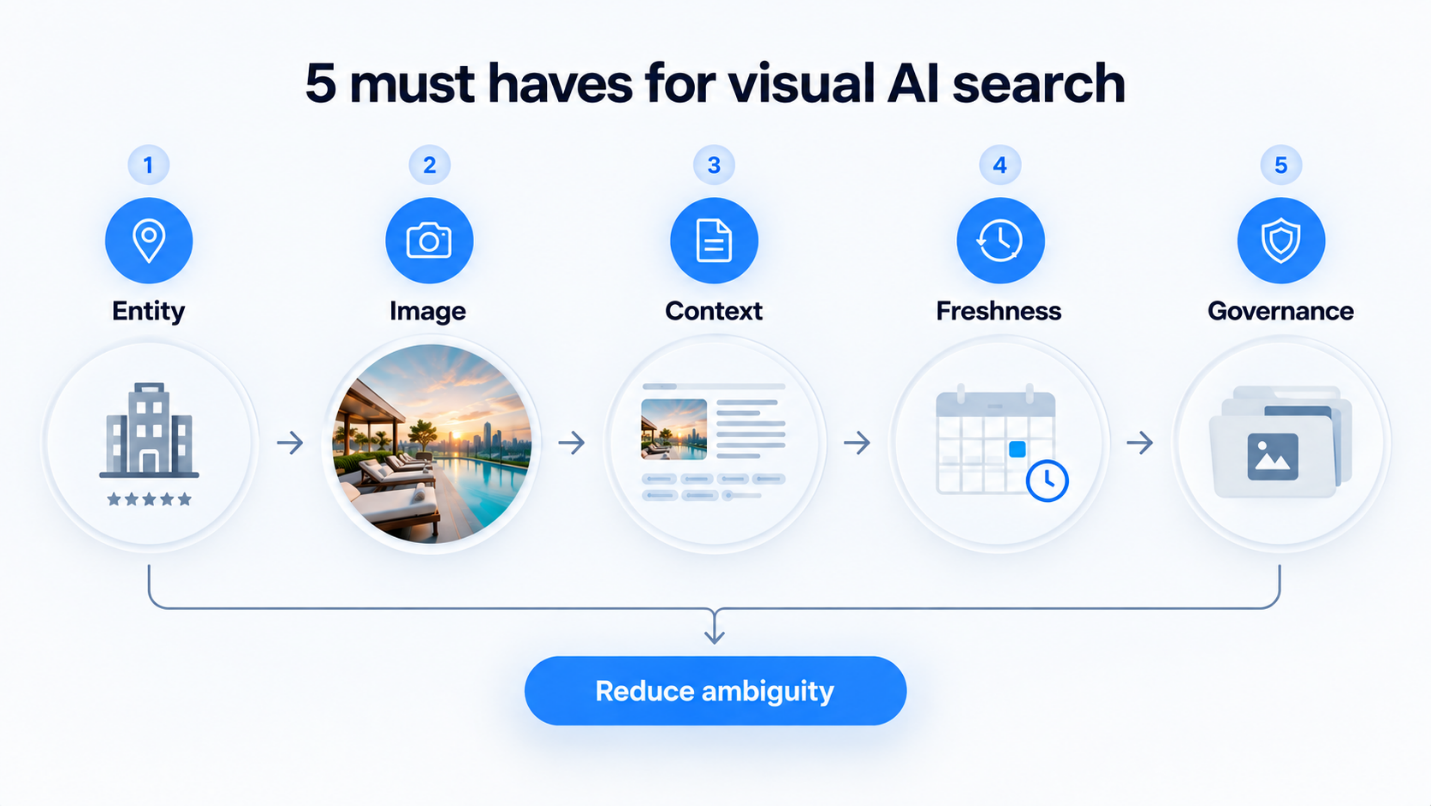
AI systems need to connect what appears in a visual with the entity it represents, the context surrounding it, and the information required to act on it.
1. Entity consistency layer
Every visual should have an unambiguous relationship to the entity it represents.
A hotel room image should connect to the correct property, room type, location, and amenities. A product image should connect to the correct product, attributes, price, and offer.
Knowledge graphs, context graphs, structured data, listings, and feeds should all reinforce the same entity and relationships. Together, these signals create an entity consistency layer around the asset.
Use relevant structured data types such as Product, Hotel, Event, and ImageObject, and keep the structured data aligned with current feeds and inventory, booking, and location data.
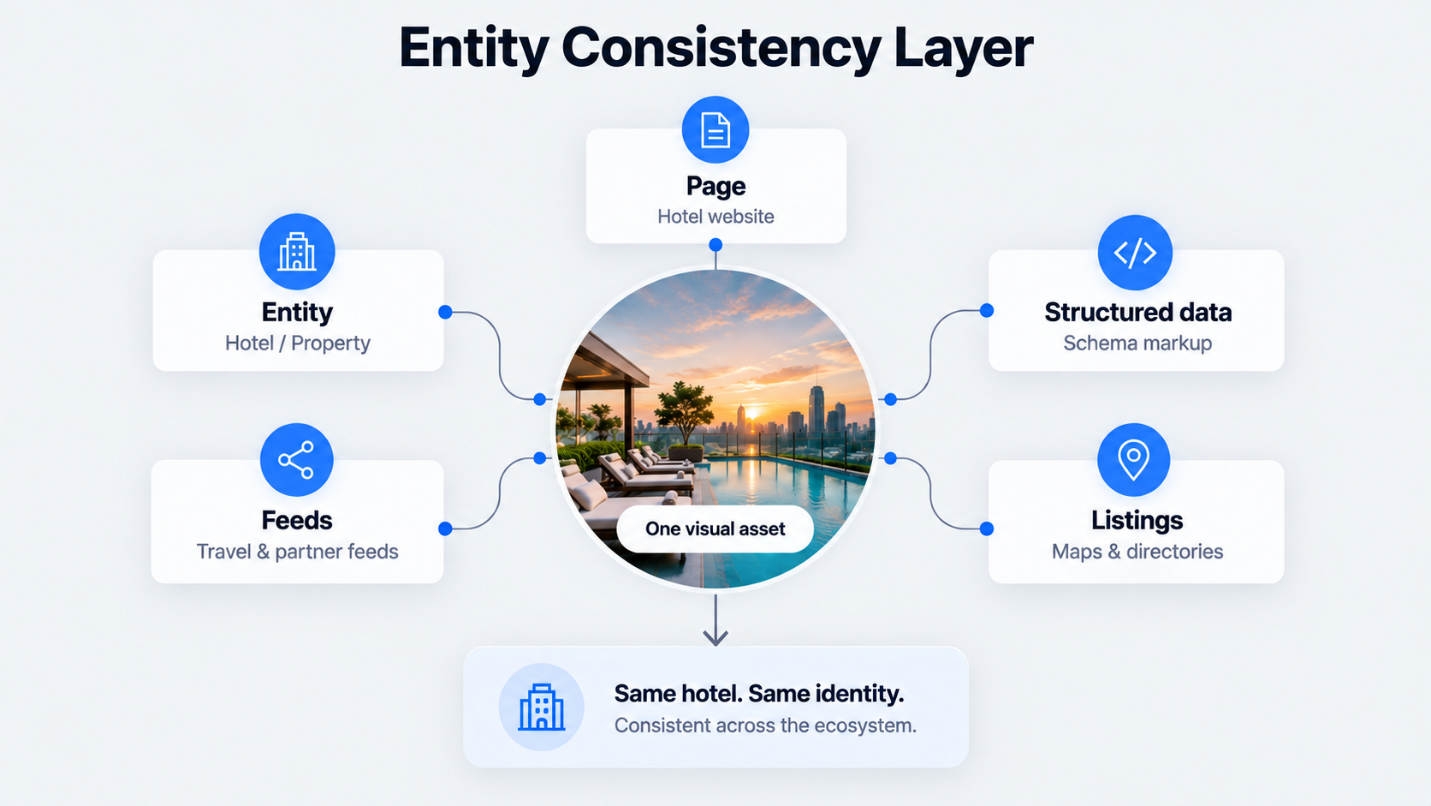
Consistency matters across every surface. Websites, profiles, publishers, booking platforms, feeds, and social channels should present the same entity, attributes, and visual information.
Entity optimization isn’t about simply adding more schema. It’s about creating one authoritative representation of the entity across the entire ecosystem.
When the visual, page, and structured data disagree, the AI system must resolve the conflicting signals before it can determine what the asset represents, which means the outcome is no longer under your control.
2. Image and attribute depth
AI systems increasingly interpret objects, attributes, and relationships within a visual. That makes quality and specificity more important than simply producing attractive imagery.
Use original imagery that clearly shows products, properties, rooms, dishes, amenities, locations, and experiences from useful perspectives. Images should portray attributes customers care about and AI systems can recognize, such as color, material, style, room type, amenity, cuisine, or product features.
A rooftop pool image, for example, can show details such as loungers, lighting, views, and pool design, giving customers and AI systems more information to evaluate the experience.
The goal is to produce imagery with sufficient visual specificity that both customers and machines understand it as the same thing.
3. Content alignment and descriptive metadata
Images shouldn’t be optimized separately from their surrounding content. In multimodal search, the image, copy, headings, captions, and metadata all work together to establish meaning. When the page changes, the visual context should remain aligned.
Traditional image and video SEO still matters. Crawlability, descriptive filenames, alt text, captions, descriptions, transcripts, and relevant surrounding content help AI systems understand what a visual represents and how it connects to an entity.
These signals form part of the semantic context around an asset and reduce ambiguity.
4. Content freshness and multi-location consistency
Visual AI search readiness isn’t static. The visual representation of a business needs to reflect the entity’s state.
Images, entity information, structured data, and surrounding content must remain aligned as prices, availability, inventory, locations, amenities, and experiences change. This becomes particularly important for businesses operating across multiple locations or for businesses that frequently change experiences.
An event provides a simple example. A localized event page can combine current event information with relevant imagery, location context, and structured data. Keeping those signals aligned gives search and AI systems a clearer representation of what is happening now.
For multi-location brands, a generic visual library can create the same ambiguity at scale. Each image should be associated with the correct property, store, restaurant, destination, or location.
The right visual should represent the right entity at the right time.
5. DAM as the source of truth for governance and provenance
Once the entity, context, and information architecture are established, the digital asset management (DAM) platform becomes the governance layer, keeping the system manageable at scale.
A digital asset manager should be the source of truth for approved assets and the metadata surrounding them, including ownership, approval status, rights, source, version, expiration date, entity association, AI-generated versus AI-edited status, and provenance.
DAM governance goes beyond just images. Videos and PDFs should also sit within the DAM and carry their own attributes and context. The DAM should reliably answer one basic question: Which asset is authoritative for this entity right now?
This becomes particularly important for multi-location brands where websites, locations, agencies, feeds, and social teams forgo alignment and publish different versions of the same visual.
The DAM can also prepare brands for provenance technologies such as SynthID and C2PA Content Credentials, which can establish where visual content originated and whether it was generated or modified.
The DAM is the system that helps enterprises govern, distribute, and maintain the entity and context relationships established earlier in the framework.
At enterprise scale, this governance layer also needs to connect to the content delivery network (CDN) and other systems that index and retrieve visual assets across websites, feeds, and other search surfaces.
The visual AI search readiness checklist
Generative AI makes visual content easier to produce but not necessarily easier to retrieve, interpret, or trust. As asset volume increases, brands need infrastructure that connects visual content to authoritative entities and context.
A mature visual SEO stack should answer five questions:
- Entity consistency layer: Is each visual connected to the correct entity, with structured data, feeds, listings, and third-party sources reinforcing the same information?
- Image and attribute depth: Do visuals clearly show products, locations, and experiences from useful perspectives, including attributes AI can recognize and match?
- Content alignment and descriptive metadata: Do page copy, headings, filenames, alt text, captions, and descriptions reinforce what the visual represents?
- Content freshness and multi-location consistency: Are prices, availability, inventory, attributes, location data, and imagery up to date and linked to the correct entity?
- DAM governance and provenance: Are approved images, videos, and PDFs governed with clear rights, versions, entity associations, and provenance signals, including AI-generated or edited status?
Visual AI search isn’t simply a new form of image optimization. It’s a broader system for reducing ambiguity across assets, entities, context, and channels.
The unit of optimization is shifting from the individual image to the relationship around it: what it represents, the context surrounding it, whether that information is current, and what action it enables. The brands best prepared for multimodal search will create the clearest connection between what people see, what AI understands, and what customers need to do next.