Google Ads Experiments with New Campaign Creation Interface
Google Ads is experimenting with a new campaign creation experience that lets advertisers describe their advertising goals in their own words, rather than immediately navigating traditional campaign setup options.
What’s New
A screenshot of the experimental interface shows a redesigned campaign creation screen asking advertisers: “What’s your goal for this campaign?”

Below the question is a large text box prompting users to describe their goal, with Google explaining that its AI will suggest goals and assets based on their input.
How It Works
Instead of beginning with predefined campaign objectives, advertisers can type a description of what they want to accomplish.
The interface also includes a “Create campaign manually” option, allowing advertisers to bypass the AI-assisted workflow.
Why We Care
The experiment could make campaign creation more conversational, allowing advertisers to start with what they want to achieve while Google’s AI suggests suitable goals and assets.
Google Confirms the Test
Google Ads Liaison Ginny Marvin confirmed that the interface is an experiment.
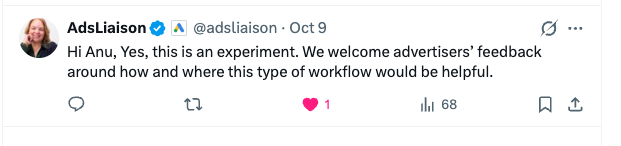
“Yes, this is an experiment. We welcome advertisers’ feedback around how and where this type of workflow would be helpful,” Marvin said.
The Potential Benefit
A conversational setup process could simplify campaign creation, particularly for advertisers who aren’t familiar with Google’s campaign types, settings and asset requirements.
It could also help translate business objectives into campaign recommendations without requiring users to understand every available advertising feature.
The Catch
Google hasn’t shared details about the experiment’s availability, rollout timeline or which campaign types it supports.
It’s also unclear how much control advertisers would have over the AI’s recommendations or how the workflow would handle more advanced campaign requirements.
The Bottom Line
Google Ads is testing a more conversational approach to campaign creation, but it’s still an experiment. Whether it becomes a useful alternative to traditional setup will depend on the quality of its recommendations and the control advertisers retain.