Introduction
A brand can be correctly categorized by LLMs while Google’s Knowledge Graph (KG) associates the same name with a completely different company, creating an unusual situation in which information about the brand exists and can be retrieved when the entity is explicitly introduced, but the brand fails to surface when the model has to retrieve relevant entities independently.
My colleague, João da Silva, and I encountered an unusual case while studying the relationship between Knowledge Graph strength and AI recommendations. Our research involved 14,140 controlled API runs covering 12 brands and five generative AI platforms.
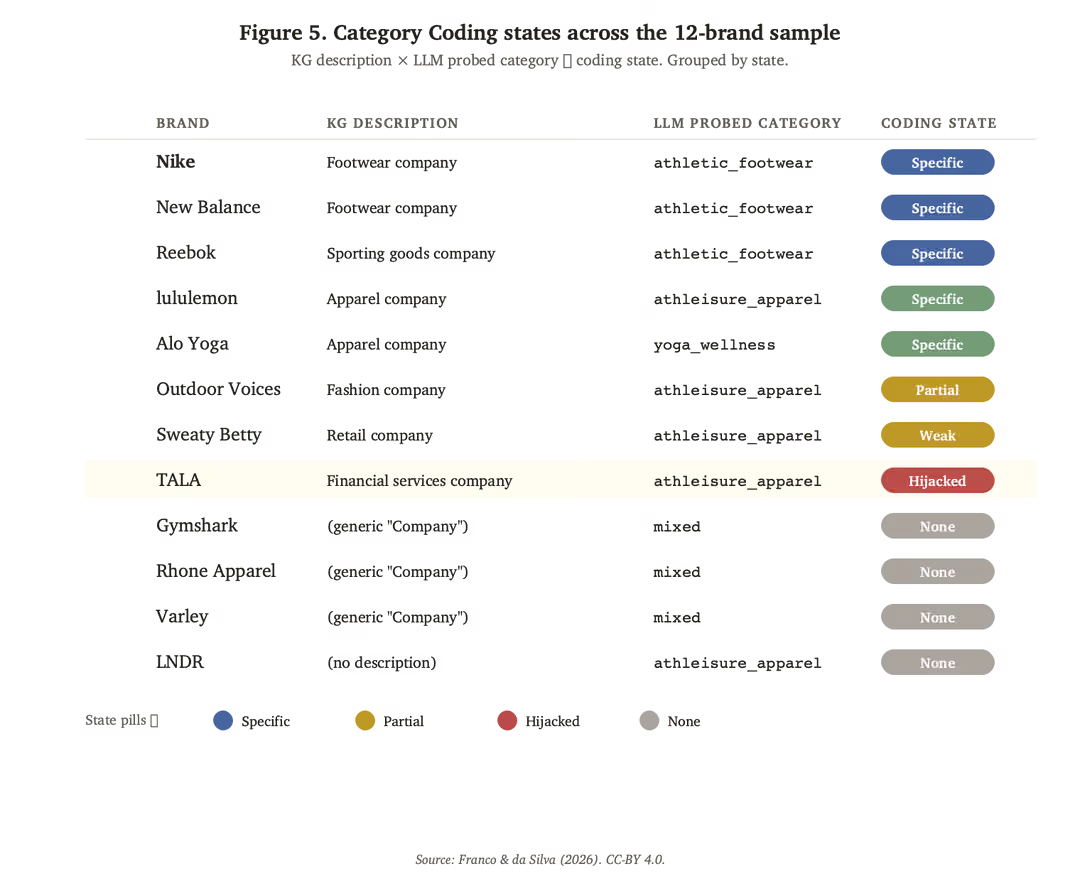
What we found was that TALA, a U.K. activewear brand, was correctly placed within “athleisure” by the LLMs in our study, while Google’s Knowledge Graph described TALA as a “financial services company,” and the brand appeared in none of the athleisure or sportswear recommendation responses we tested. The brand fits a pattern we call a KG-hijacked entity.
Beyond the Recognition-Recommendation Gap
I’ve written multiple times about the recognition-recommendation gap: the difference between an LLM knowing who a brand is and actually recommending it. The TALA case adds another layer to that problem because the conflict appears to begin earlier, with the relationship between the name and the entity it represents.
If the same name refers to multiple organizations, and one of the strongest structured representations of that name points toward a different organization altogether, improving category association or producing more content may be addressing a downstream problem before the entity-level conflict has been resolved.
The Entity-Resolution Problem
This case illustrates a basic entity-resolution problem that becomes considerably more important once we start measuring AI visibility. A name isn’t necessarily an entity, but a label that can refer to one or several entities, and a system encountering that label needs enough information to determine which person, company, product, place, or concept is intended before the surrounding attributes and relationships can be attached correctly.
Apple is an obvious textbook example because the same string can refer to a technology company, a fruit, a record label, and numerous other entities. Commercial names create the same problem on a smaller scale every day.
When Two Very Different Companies Share the Same Name
TALA shares its name with a financial services company. Yet all four systems included in the category-probing portion of the study correctly classified the activewear brand as athleisure_apparel, which tells us that information connecting it to its correct commercial category was available to the models.
Entity ambiguity of this kind is already a familiar issue in SEO. For example, Jason Barnard documented a particularly useful example on Search Engine Land involving Danny Goodwin, where Google’s systems had conflated Search Engine Land’s Danny Goodwin with a baseball player of the same name and were associating articles written by the former with the entity of the latter.
The case demonstrated how two perfectly real entities can become entangled when the machine doesn’t have sufficiently clear and corroborated signals to distinguish which attributes belong to which entity.
We describe this particular state in the research as a KG-hijacked entity: a case where the Knowledge Graph result associated with a brand name points toward an unrelated entity, creating an entity-level conflict that coincides with weak or absent recommendation visibility for the intended brand.
Recognition, Categorization, and Recommendation Are Different Tests
Asking an LLM what category TALA belongs to already supplies the brand name and narrows the task considerably. The system has to resolve the intended entity and determine which category is associated with it. Once the activewear entity is correctly identified, the tested models consistently associate it with athleisure apparel.
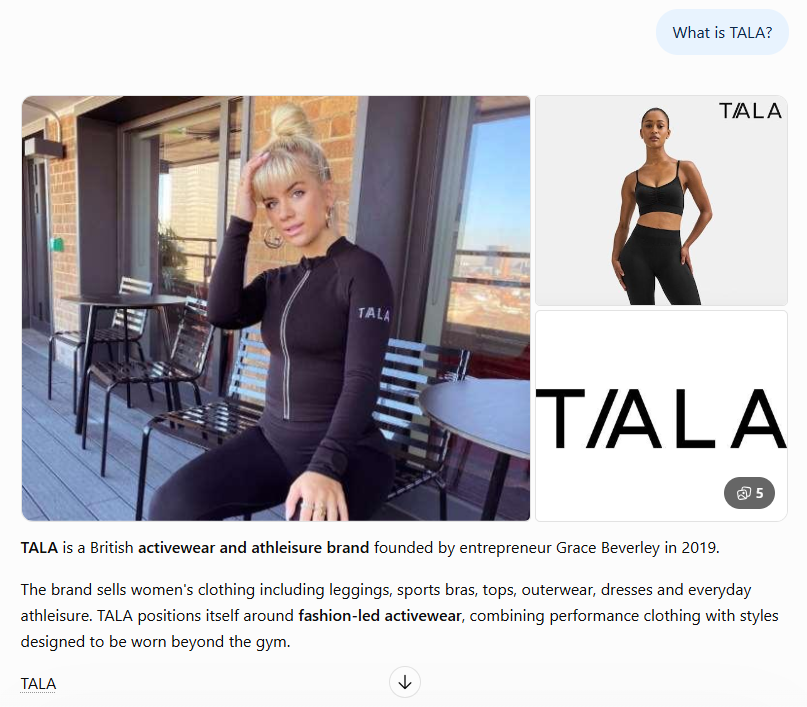 ChatGPT result for the query: What is TALA?
What Happens When You Remove the Brand from the Prompt?
A recommendation prompt works in the opposite direction. When somebody asks for recommended athleisure brands, the brand is absent from the prompt and the system has to begin with the category, identify entities sufficiently associated with it, assemble possible candidates, and determine which belong in the answer. Information about TALA existing within the model’s parametric knowledge or available retrieval environment doesn’t guarantee that TALA will become one of those candidates.
Recognition was less consistent. TALA’s recognition score varied depending on whether the system resolved the name to the activewear company or the fintech entity, while category classification became consistent once the intended apparel entity was established.
The Knowledge Graph result simultaneously supplied a description belonging to the financial services company. Taken together, these observations point toward an entity-resolution conflict upstream of the recommendation problem rather than a straightforward case of a known brand lacking sufficient category association.
Our broader study describes the relationship between the Knowledge Graph description and the category-aligned third-party corpus surrounding an entity as category coding. An entity’s category emerges from a wider information environment in which structured entity descriptions and accumulated third-party associations can reinforce, weaken, or contradict one another.
TALA is unusual because those signals visibly diverge: the LLMs can recover an athleisure interpretation when the apparel entity is explicitly probed, while the Knowledge Graph anchor attached to the shared name belongs to an entirely different commercial category.
Entity Ambiguity Doesn’t Automatically Mean Entity Hijacking
Any organization sharing its name with another identifiable entity has some degree of ambiguity, and that condition alone doesn’t constitute a KG hijack. Systems resolve ambiguous names constantly by using context, attributes, relationships, and corroborating information to determine which entity is intended.
What Makes a KG-Hijacked Entity Different?
The KG-hijacked state is narrower. In the framework developed from our study, it describes the situation in which the Knowledge Graph result associated with the name resolves toward an unrelated entity, as happened when an apparel brand returned the description “Financial services company.”
A company with a generic or weak Knowledge Graph description has a different problem from a company whose name is already strongly associated with somebody else. In the latter case, existing information is divided between competing entities and needs to be disentangled.
This also places the problem slightly upstream from the framing gap Barnard has previously described. The framing gap concerns the interpretive context required for AI systems to connect available evidence to the conclusion a brand wants them to make, whereas the TALA case concerns whether the correct entity can first be reached consistently and associated with the appropriate information environment.
Our research treats these as adjacent layers: framing concerns how the available evidence is interpreted, while entity resolution and Category Coding help determine which entity and which body of evidence are available for that interpretation.
Why Zero AI Recommendations Can Signal Different Problems
One reason I find this case useful beyond TALA itself is that recommendation visibility tells us very little about the underlying problem when it’s measured alone.
Several brands in our study produced zero or very low recommendation visibility under particular category conditions, but the evidence around those brands pointed toward substantially different explanations and different optimization priorities.
New Balance: Strong Entity, Wrong Category
New Balance provides the clearest contrast. It had the highest Knowledge Graph result score in our sample and a recognition score of 1.0, yet it received zero athleisure recommendations.
Its Knowledge Graph description identified it as a footwear company and all four directly probed LLMs categorized it as athletic footwear, so the absence from athleisure recommendations was consistent with the category representation surrounding the brand. The entity was clear — its association with the category being requested was the constraint.
LNDR: Weak Entity Signals
LNDR, another athleisure company aimed at women, produced another version of zero, this time alongside extremely weak entity signals and no recommendation visibility across either tested category.
TALA sat somewhere structurally different from both: The models could categorize the intended apparel entity correctly, but recognition of the shared name was unstable and the Knowledge Graph description belonged to another company.
Three superficially similar dashboard results could represent category misalignment, weak entity establishment, or an entity collision, and treating all three as a generic "AI visibility problem" would make it very easy to prescribe the wrong work.
This is also why I’m cautious about AI visibility scores that compress recognition, mentions, citations, and recommendations into a single number: the percentage describes the outcome while removing much of the information required to diagnose its cause.
How to Diagnose an Entity-Resolution Problem
A useful diagnosis needs to separate the stages rather than beginning and ending with a recommendation share-of-voice report.
1. Remove the Context
Start with deliberately context-poor recognition prompts such as:
- "What is [Brand]?"
- "What does [Brand] do?"
- "Describe [Brand]."
- "What company is [Brand]?"
- "Tell me about [Brand]."
The interesting part is finding whether the same entity is resolved consistently across variations of the prompt and, ideally, across multiple systems. Pay attention to requests for clarification, different companies appearing under different prompts, and answers that mix attributes belonging to separate entities.
2. Test Categorization Separately
Once the intended entity is established, ask which category the system associates with it, either openly or using a controlled category set when comparable results are required.
A brand that is inconsistently recognized but consistently categorized once disambiguated is exhibiting a different failure pattern from a brand that is consistently recognized but repeatedly placed in the wrong category.
3. Inspect the Knowledge Graph
The description associated with the returned entity deserves particular attention rather than simply checking whether a Knowledge Graph result exists. A description such as “Footwear company,” “Apparel company,” or “Financial services company” provides a compact indication of how that entity is represented at the graph level, and a description belonging unmistakably to another organization is a much stronger diagnostic signal than a merely generic description.
4. Remove the Brand from the Prompt
Recommendation prompts test whether the entity can surface when its name is absent altogether.
- Recognition asks whether the system can resolve the brand.
- Categorization asks what the resolved entity represents.
- Recommendation asks whether that entity can enter consideration when the category rather than the brand initiates the query.
Looking at all three together provides considerably more diagnostic information than asking whether "AI knows the brand."
Fixing the Entity Before Fixing the Recommendation
A confirmed entity collision changes the optimization priority because the immediate task becomes disambiguation:
- Establishing that two organizations sharing a name are distinct entities.
- Making the identities, attributes, relationships, and authoritative references belonging to each sufficiently explicit and consistent so that they can be separated reliably.
Depending on the case, that can involve strengthening the entity home, reconciling organization information and aliases across authoritative profiles, clarifying relationships with founders, products, and other known entities, obtaining corroboration from relevant third-party sources, and submitting corrections where Google’s Knowledge Graph contains an incorrect or conflated representation.
The Danny Goodwin case is a useful example here because it shows that entrenched entity confusion can be corrected when the information environment is systematically reconciled, although the precise implementation for a company will naturally differ from that of a person.
The objective is to provide enough consistent evidence for the machine to distinguish between two entities rather than simply increasing the volume of information containing the ambiguous name.
Correlation Isn’t Causation
There’s an important limitation to the TALA finding. Our observational data show a collision among the Knowledge Graph description, variable recognition, correct category classification once the intended entity is reached, and zero recommendation visibility, but it doesn’t establish that the Knowledge Graph mismatch caused the zero recommendation rate.
The research treats the causal relationship as a testable prediction: if the KG collision is materially contributing to TALA’s recommendation failure, successfully disambiguating the entities should produce a measurable shift in recommendation behavior.
This is important to keep in mind because we’re observing proprietary AI systems from the outside. Controlled experiments can compare behaviors and identify relationships between observable variables, but they can’t automatically tell us the internal weighting or causal mechanisms responsible for those behaviors.
In TALA’s case, the evidence gives us a strong diagnostic direction and a hypothesis worth testing, rather than proof that changing one Knowledge Graph field will automatically produce recommendations.
Entity Resolution Belongs in AI Visibility Audits
Before treating poor AI recommendation visibility as a content problem, check whether AI systems can consistently identify the correct brand. Brands with short or common names, acronyms, rebrands, or names shared with established organizations are especially vulnerable to entity confusion.
An LLM may correctly describe a brand when given enough context, but that doesn’t mean it can reliably identify the same entity when the brand isn’t explicitly named.
Recommendation share, citations, and mentions show what happened at the output layer. Recognition and entity resolution help explain why.