Introduction
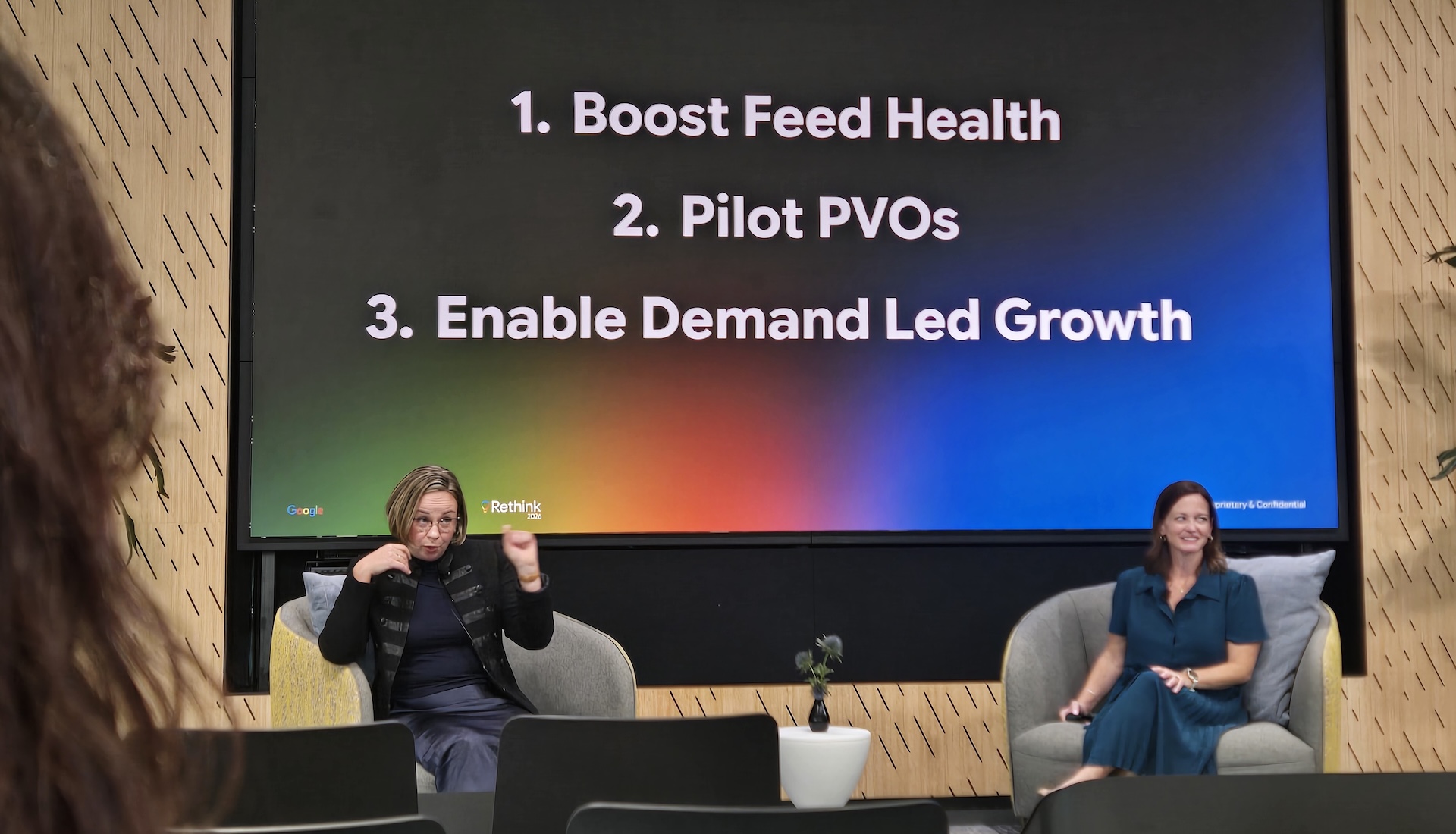
One of the biggest themes at Rethink Retail and Rethink ROI was Google encouraging advertisers to switch to “demand-led” budgeting.
Essentially, Google says you should fully fund campaigns that perform well and never let budget limits hold them back. Google has also called this “enabling demand-led growth.”
It makes sense that Google wants you to take this approach. Google makes more money when advertisers spend more.
The recommendation is nothing new. Google has encouraged advertisers to spend more for years.
What interests me, though, is how the data Google presented supports this recommendation.
Search is becoming more complex and less predictable
Queries are getting longer. Thirty-eight percent of retail queries are more than eight words long. AI Mode queries are more than three times as long as regular queries.
AI Mode adoption is also growing, with more than 1 billion monthly users. But keywords can’t exceed 10 words. That makes it difficult to account for every possible query in a campaign. As searches become more complex, AI Max becomes more necessary to show up across them.
Search demand is also unpredictable. When a product goes viral, searches can spike. But what makes a product go viral? Sometimes no one knows, and it can be difficult to predict. Viral activity driven by user-generated content can be especially unpredictable.
That means you could hit a daily budget limit on any given day, regardless of the budget you set. If a product goes viral, some searches missed because of that limit could have been profitable ones the business wanted to capture.
The cost of going dark
Google also presented data showing that shoppers aren’t brand loyal. Two out of three shoppers buy a completely different brand from the one they initially discovered, whether through a creator video or a ChatGPT recommendation.
So if a brand isn’t advertising, whether because of budget limits or another reason, the shopper is more likely than not to buy from a different seller or brand.
At Rethink Retail, Google illustrated this with two storefronts selling the same product. One has the lights on and a line out the door. The other is dark and closed.
The argument is that when an advertiser doesn’t appear for a query because of budget limits, it’s like closing the store. The prospective buyer will go elsewhere.
Adding predictability to demand-led budgeting
Demand-led budgeting is supposed to help fill this gap. It allows brands to stay present when demand is high, as long as that demand would be profitable.
Google’s recent change to bid strategies that optimize toward target CPA and target ROAS aims to reduce some of the uncertainty around unlimited scaling. Essentially, Google is trying to promise that if an advertiser is comfortable scaling at a 3x ROI, for example, it can scale at a 3x ROI. If Google can’t achieve that ROI, the ads won’t serve.
This change also supports the shift to demand-led budgeting. It gives you a clearer idea of what to expect as you increase spend. It also provides a safeguard: when campaigns reach a point of diminishing returns below the company’s desired performance threshold, they’ll stop serving.
Google has also used this data to give advertisers more predictability, at least in theory, about incremental spend. Tools like Performance Planner can help you decide where to allocate that spend and what return to expect.
Most companies don’t have unlimited marketing budgets. Most advertisers don’t think this way either, as anyone who has gone through annual budgeting can attest. And companies aren’t going to change how they plan and set annual budgets because Google Ads told them to.
Still, it’s an interesting lens through which to view Google’s new ideal state.
Google has consistently asked advertisers to spend more money, and doing so is obviously in Google’s business interests. But by reframing that conversation around adding predictability to unpredictable demand, Google makes, in my opinion, a stronger business argument worth considering.
More control through AI briefs
To further support the case for demand-led budgeting, Google announced two relatively new features: AI Briefs and Product Value Optimization.
AI Briefs give you more control over AI Max campaigns. Google says AI Briefs for Performance Max and AI Max for Shopping campaigns will follow soon.
These briefs let you provide several types of guardrails. You can set messaging guidelines, such as “never include the word ‘free.’” They can also set matching guidelines, such as “avoid searches related to X,” and audience guidelines, such as “show our clean products to health-conscious shoppers.”
Product-level control without new campaign structures
Product Value Optimization is another valuable new feature. It lets merchants tell Google Ads to prioritize certain products without changing campaign structures each time.
The feature allows SKU-level bid adjustments in Google Ads. You can bid individual products up or down without creating separate feeds or excluding every other product from the feed.
Product Value Optimization also gives marketers and merchants a useful way to collaborate. You can adjust bids faster as inventory needs change.
Google’s vision for demand-led budgeting
Together, these two features give advertisers more scalable control over their campaigns. Google is trying to provide guidelines and guardrails without requiring marketers to account for every possible keyword, audience, headline, or description—or maintain multiple product feeds.
These features address some of the biggest objections to AI Max and similar tools. In theory, they make it easier for Google to adapt in real time to new queries, trends, and audiences.
Many advertisers will remain unwilling or unable to give up manual control over their keywords, copy, or audiences. Others can’t adopt demand-led budgeting because of the company’s or finance policies.
Still, Google is clearly building toward a future centered on demand-led budgeting. It will be telling to see whether advertisers follow.